
⏱️ Read time: 7 minutes
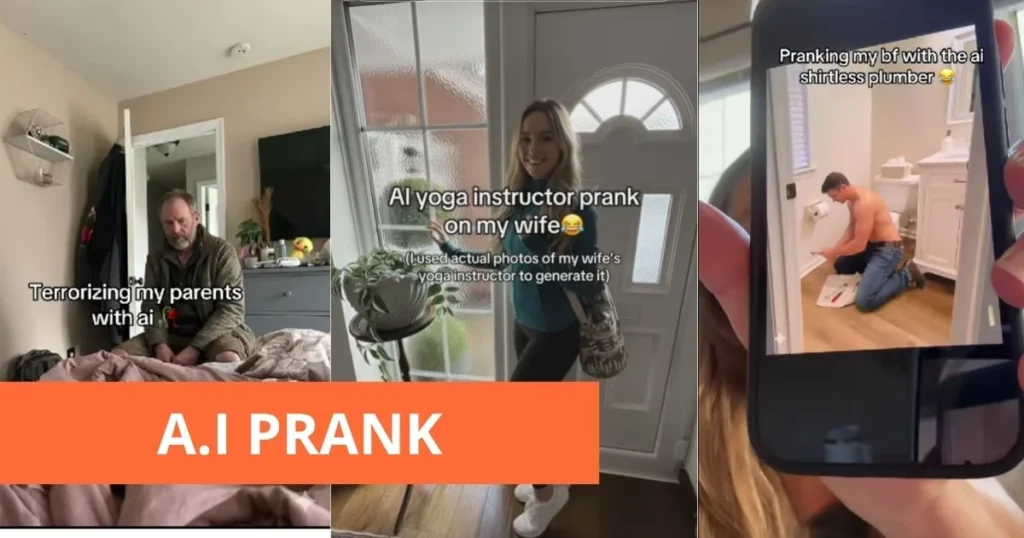
The AI prank on TikTok is a hoax built on one AI-generated picture. You take a photo of your living room, ask Gemini or Snapchat to add a stranger to it, text it to a parent with something like “he knocked, so I let him in”, then post their reply. The best-known version, the “AI homeless man prank” of fall 2025, ended with real 911 calls in the US, the UK and Ireland. Below: where it came from, how to do a version that won’t bring the police to your door, and how to turn it into TikTok views.
Where did the AI prank on TikTok start?
Know Your Meme traces the first video to September 25, 2025. TikToker @princessdasha123 shared an iMessage chat with her mom about a man eating her snacks in the kitchen. The next day @levy.gabriella posted the same setup with her dad, and her video passed 1.9 million views in six days.
After that it moved fast. On September 29, @sarahmccullough_ hit 5.6 million views in three days. On the 30th, @lovedumplings666 reached 5.9 million views in two. The picture barely changed from one video to the next: a scruffy, tired-looking man on the couch or asleep in the bed. Hence the name people searched for, “AI homeless man prank”.
The first images came from the photo editing tool that Snapchat+ gives its paying subscribers. Once The Tab published a step-by-step guide on October 1, 2025, most people switched to Gemini, Google’s image generator. The trend crossed the Atlantic within days. This Swiss couple nearly had the police show up:
@aleundseija Er het fast de polizei ahglüte willer ned dehei gsi isch😂🫠 #homelessman #ai #prank #switzerland
How does the prank work?
There are four parts. A real photo of your home, so the setting holds up. A stranger added by AI, with lighting and shadows that match. A boring text message that makes the scene believable. And finally the screenshot of the panicked answer, cut into a video with some ironic music.
The trouble is that it works too well. On October 6, 2025, Salem police in Massachusetts put out a statement: several parents had believed the intrusion was real and called 911. Officers responding had no idea it was a joke and treated the call as a burglary in progress. By October 10, NBC News had counted warnings from Oak Harbor (Washington), Round Rock (Texas), Brown County (Ohio), Dorset Police in the UK and Ireland’s Garda. Two juveniles were charged in Ohio. “This behavior is not a ‘prank’, it is a crime,” the Brown County sheriff’s office wrote.
ABC News covered the police warnings here:
@abcnews The viral “AI homeless man prank,” which involves artificially generated images of a “homeless man,” has prompted police warnings over safety concerns, with officials calling it “stupid and potentially dangerous.” #news #homelessmanprank #prank #police
TikTok responded by adding an “AI-generated” label to the videos NBC flagged. Its Community Guidelines already require creators to label AI content that shows realistic scenes or people.
Why did it spread so fast?
Because the reaction is real. Viewers aren’t watching an AI image, they’re watching a dad type “CALL THE POLICE” in all caps. That kind of raw panic keeps people watching to the end, and TikTok pushes videos people finish.
It was also easy. You didn’t need editing skills: one photo, one prompt in Gemini, three screenshots. Anyone could copy the format in ten minutes, which is usually what turns a video into a trend.
The backlash came quickly. Salem police said the prank “dehumanizes the homeless”, and plenty of commenters agreed. In the UK, Dorset Police sent officers after “a call from an extremely concerned parent”, according to the BBC. If the point of your video is to grow your account, an angry comment section is not the audience you want.
A year on, the format survives in gentler forms: the “builder prank” (a workman who ripped his trousers and asks to borrow a pair, per The Tab on October 3, 2025), the shirtless plumber, and in September 2026 the ancestor photo prank, where the fake picture is of a long-lost ancestor.
Can a brand use it?
Yes, but only the harmless version. A brand that fakes a break-in gets a PR mess and, in some places, a visit from the police. The ones that pull it off go absurd: a sofa from the new collection appearing in a customer’s living room, a courier turning up with twelve boxes of croissants, the store mascot sitting in a bathtub.
Two rules. The reveal happens inside the video, never in the comments. And the AI label stays on. A company account caught fooling its audience loses more than it gains. For a new account, a base of TikTok followers also makes the profile look credible when a video starts to travel.
Your AI prank deserves more than twenty friends?
On TikTok, the first few hours decide everything. A boost in views gives your video the start the algorithm needs to show it further.
FAQ
What is the AI prank on TikTok? definition
Is the AI homeless man prank illegal? law
What app do people use for the AI prank? tool
Does TikTok remove AI prank videos? rules
Is the AI prank still a trend in 2026? timing
Our TikTok offers
-
TikTok
Buy Tiktok Followers
Price range: 2,90 € through 999,90 € View offers This product has multiple variants. The options may be chosen on the product page -
TikTok
Buy TikTok likes
Price range: 3,90 € through 1999,90 € View offers This product has multiple variants. The options may be chosen on the product page -
TikTok
Buy Tiktok Shares
Price range: 5,90 € through 6999,90 € View offers This product has multiple variants. The options may be chosen on the product page -
TikTok
Buy TikTok views
Price range: 2,90 € through 794,90 € View offers This product has multiple variants. The options may be chosen on the product page

How do you do an AI prank without getting in trouble?