⏱️ Reading time: 8 minutes
Instagram pays you directly through four tools: Gifts on Reels (from 500 followers), paid Subscriptions (from 10,000), Badges during Lives, and invite-only bonuses. Those are the rules in the Help Center as we read them on September 23, 2026. Most of the money, though, comes from somewhere else: brand deals, affiliate links and selling your own products. All of it starts with an audience that follows you for a clear reason. If your account is new and needs a visible base, there are our Instagram followers.
What are the ways to make money on Instagram?
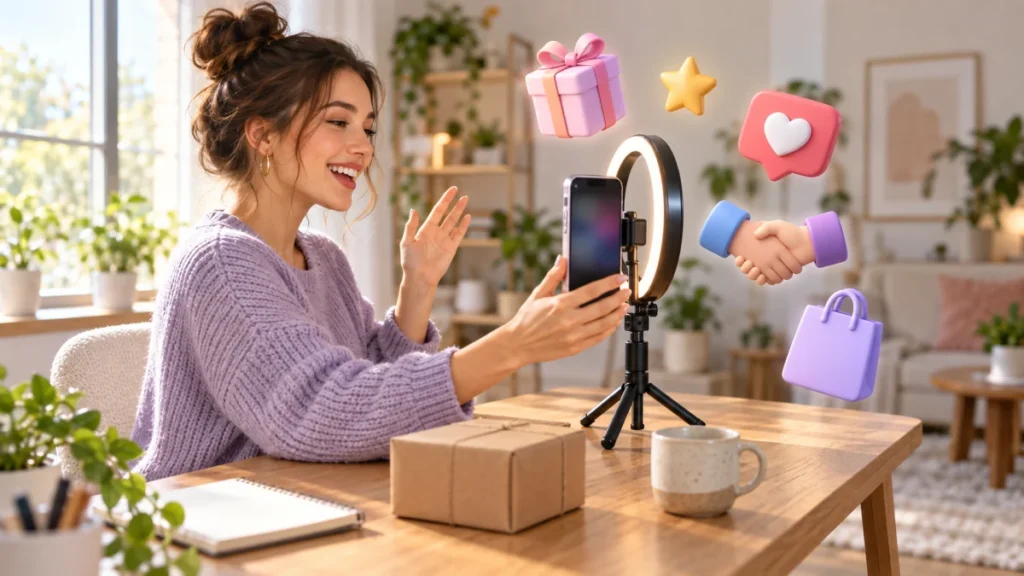
There are two families of income, and people mix them up all the time. One is money Meta sends you directly, with strict rules and a list of countries. The other is money other people pay you because your Instagram account brings them customers. The second family almost always pays more, and it has no official threshold at all.
| Source | Who pays | Main requirement |
|---|---|---|
| Gifts on Reels | 500 followers, 18+, professional account | |
| Paid Subscriptions | Your fans, through Instagram | 10,000 followers, 18+ |
| Badges in Lives | Your viewers, through Instagram | 18+, living in one of 11 listed countries |
| Bonuses | Invitation only | |
| Brand deals | Brands | No threshold; 1,000 followers for Meta’s Creator Marketplace |
| Affiliate links | Brands, on commission | No threshold |
| Your own products and services | Your customers | No threshold |
TikTok works in a similar way with different thresholds, which we cover in our guide on how to make money on TikTok.
What does Instagram pay for itself?
Gifts on Reels
Any viewer, follower or not, can buy Stars and send them to you under a Reel. Instagram pays you $0.01 per Star received, once a month. You need a professional account, to be 18 or older, at least 500 followers, to accept the Gifts terms and to have a payout account set up. Without that account you can see who sent you a gift, but you earn nothing from it. Collab posts are not eligible.
The United States, the United Kingdom, Canada, Australia, Ireland and New Zealand are all on the list of eligible countries. On the buyer’s side, Apple and Google usually take 30% of the Star pack, and Instagram takes its own share at purchase. That’s why a gift a fan paid $1 for does not put $1 in your pocket.
Paid Subscriptions
Your most loyal followers pay every month for subscriber-only stories, Reels, Lives or a broadcast channel. You need 10,000 followers, to be 18+ and a professional account. Instagram’s own cut is 0%, but Apple and Google take 30% on in-app purchases. You pick the price from a fixed list: Influencer Marketing Hub reported tiers from $0.99 to $99.99 a month in February 2026.
Badges in Lives
During a Live, viewers buy badges that show next to their name. Instagram takes nothing, the app stores take 30%, and one viewer can spend at most $250 per Live. The catch is geography: the creator has to live in one of these 11 countries, the United States, United Kingdom, Germany, Brazil, France, Italy, Turkey, Spain, Mexico, Japan or Australia. Creators in Canada, Ireland or New Zealand don’t get Badges. The Live walkthrough is in our article on how to go live on Instagram.
Bonuses
Instagram tests bonus programs “by invitation only for a limited time”, with an element of random selection, according to its own Help Center. You can’t apply. The invite shows up in your professional dashboard, as a notification or as an email from Meta. Watch out for fakes: a real invitation never asks for your password.
How do you turn on monetization, step by step?
- Switch to a professional account (creator or business) from your profile settings. None of the monetization tools open on a personal account.
- Check your age and country: 18 is the minimum everywhere, and you need to live in a country on that tool’s list. Move outside the list and Instagram can switch the tool off.
- Go to your profile and tap Professional dashboard. The tools your account qualifies for show up there. If you’re eligible for Subscriptions, you’ll see Set up subscriptions.
- Set up your payout account: name, tax details, payment method. Without it, you don’t get paid for the gifts you receive.
- Accept the terms of each tool. Gifts and Subscriptions have separate ones.
- Post original Reels and check your earnings a month later. Payouts are monthly.
Nothing shows up? Your account is missing a requirement, usually the follower count or the country. The dashboard doesn’t always tell you which one.
Getting paid by viewers under a Reel: a social media manager shows how Instagram Gifts work. ♬ son original – Manue – SMM/CM 🌸
Watch on TikTok
How do you land a paid partnership?
This is where most of the income is made. A brand isn’t buying a follower count. It’s buying the attention of a specific audience. Here is the order that works.
- Pick one clear topic that your bio sums up in a line. A coffee brand wants to know in three seconds that you talk about coffee.
- Build a one-page media kit: who follows you (age, countries, cities), your average reach over 30 days, two or three past collaborations, even unpaid ones.
- Join Meta’s Creator Marketplace if you have at least 1,000 followers, are 18+ and run a public professional account. Brands search it by topic.
- Pitch ten brands you already use, with one precise content idea instead of a vague request to collaborate.
- Price each deliverable (one Reel, three stories, usage rights for the brand’s ads) and get a signed quote.
- Disclose the deal with Instagram’s Paid partnership label, and follow the ad disclosure rules of your country.
How I make money on Instagram: a French creator walks through her income sources. ♬ son original – louannemanshow – louannemanshow
Watch on TikTok
A Reel with a lively comment section reassures a brand as much as a big follower count. To keep a test video from sitting there in silence, Instagram comments get the conversation going.
Can you make money without hitting a threshold?
Yes, and that’s usually where people start. Affiliate marketing pays you a commission on sales made through your link or promo code: retailer programs, affiliate networks, codes a brand gives you. Your link goes in your bio or in a link sticker in stories.
Selling your own products or services pays more per customer: a course, coaching sessions, photo presets, a local service. An account of 2,000 people who really care about your topic can fill a coach’s calendar.
UGC work means filming videos that the brand posts on its own accounts. Your follower count barely matters here. What sells is how you film.
And Facebook, unlike Instagram, does pay for views. Since March 18, 2026, the Creator Fast Track program pays $100 to $3,000 a month for three months to Instagram, TikTok or YouTube creators who post 15 Reels a month on Facebook. You need at least 20,000 followers and to live in the United States, Canada, the United Kingdom or Australia. If you’re there and you qualify, it’s the closest thing to getting paid per view with Meta.
How much does it actually pay?
Meta publishes no rate card apart from the $0.01 per Star. For brand deals, the most quoted benchmark is Influencer Marketing Hub’s rates guide, updated on August 31, 2026, which gives these ranges per post:
- under 10,000 followers: $10 to $100, often in exchange for a free product;
- 10,000 to 100,000: $100 to $500;
- 100,000 to 500,000: $500 to $5,000;
- 500,000 to 1 million: $5,000 to $10,000;
- over a million: more than $10,000.
These are US averages, not official prices. A very engaged niche account sells above them, an account with a scattered audience well below. It often makes more sense to think in revenue per customer or per sale: twenty coaching clients are worth more than one $300 sponsored Reel.
What makes you lose monetization?
Instagram’s monetization policies go further than its Community Guidelines. They rule out:
- unoriginal content reposted without meaningful changes (commentary, parody, creative editing);
- low-effort formats: a still image over audio, slideshows, looping videos, text montages;
- engagement bait such as “like if you agree” posted only to inflate interactions;
- accounts that mainly post content focused on children, which can’t earn from Gifts or Subscriptions;
- audiences made up in large part of fake engagement.
On that last point Meta is explicit. Its policy says a creator can lose monetization if their audience “significantly consists of fake engagement”, including likes, follows and views. A starting boost helps a profile look credible to visitors and brands. It doesn’t replace a real community, and it shouldn’t be used to cross a monetization threshold.
A profile brands can trust at first glance
Followers delivered gradually, and we never ask for your password.