⏱️ Reading time: 8 minutes
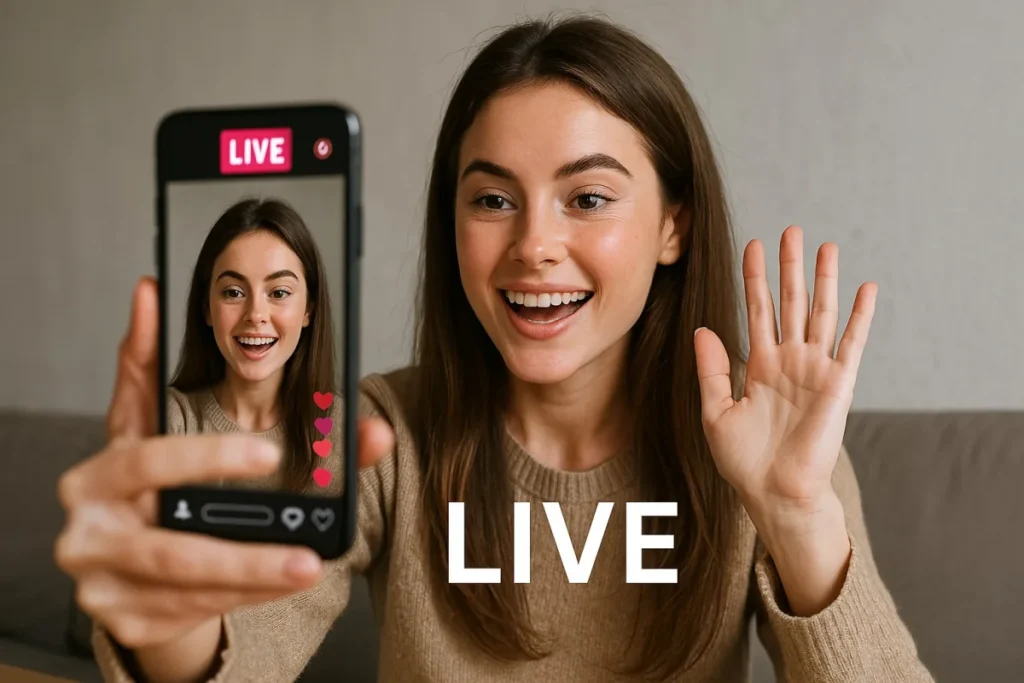
Going live on Instagram takes three taps: the + button, the mode carousel at the bottom of the camera screen, then Live. The catch is that since 1 August 2025 the feature is limited to public accounts with at least 1,000 followers. If your Live option has vanished or sits greyed out, that threshold is almost always the reason, and no setting gets around it. Clearing it is therefore step one, which is where Instagram followers come in. The rest of this page covers the flow, guests, moderation and what cuts a broadcast off.
Who can go live, and why you can’t
This is the part almost no guide leads with, and it is the one blocking most people. On 1 August 2025, Instagram restricted live broadcasting to accounts that meet two conditions at once: the account must be public, and it must have at least 1,000 followers. Below that, the option no longer shows up in the mode carousel at all.
So if you have been hunting for the button for ten minutes, stop digging through settings. Open your profile, check your follower count, check whether the account is public. The diagnosis takes five seconds.
Two honest caveats on this rule. First, the threshold is 1,000 followers, not 1,000 views and not 1,000 likes. Second, what exactly happens to private accounts in 2026 has never been spelled out in a clear official statement: going by the 2025 announcement a private account should not be able to broadcast, but treat that as likely rather than confirmed.
The threshold is also good news in disguise. Instagram does not push an empty broadcast, and talking to nobody wears thin fast. Build a real base first, with a steady Reels habit and, to speed things up, Instagram likes on the posts that bring those followers in.
How to go live, step by step
Once you clear the conditions, the path is short. You need the mobile app: the web version cannot start a broadcast.
- Tap the + button at the bottom of the screen, or swipe right from your feed.
- At the bottom of the camera screen, scroll the mode carousel: Post, Story, Reels, Live.
- Select Live. The camera switches to broadcast mode and your pre-launch options appear.
- Add a title. This is what someone dropping in halfway through reads first, so write the promise rather than the word “live”.
- Check which camera is active, your light and your framing, then start.
You can also schedule a live up to 90 days ahead from the same screens. Scheduling creates an announcement your followers can save a reminder for, which solves most of the audience problem: nobody stumbles onto an unannounced broadcast.
@chooseyoursocial The flow on video: plus button, mode carousel, then Live.
Choosing who sees you before you start
Before you tap start, the pre-launch screen offers three audiences, and the third is the one everybody should use at least once.
- Public: every follower gets a notification and the broadcast appears at the top of the feed.
- Close friends: only your close friends list sees it. That list is never visible to anyone, including the people on it.
- Practice: you broadcast for real, with every feature active, but nobody can see you. This is the mode for testing your sound, your lighting and your running order with no audience.
On top of that choice, a global privacy setting lets you hide your story and your lives from specific accounts. They stay followers, you are not blocking them, they simply stop seeing you at the top of their feed. Handy when you want to broadcast for work without summoning your family.
Inviting up to three people
An Instagram live holds four people on screen at most: you and three guests. That is the feature Instagram announced in 2021 as Live Rooms, and the ceiling has not moved since.
During the broadcast, the guest icon lets you invite a viewer or accept a request to join. Followers of every participant get a notification, so the audiences stack: going live with an account of similar size is still the simplest reach lever on Instagram, and it costs nothing.
Tell your guest to mute their notifications. An incoming call drops a guest out of the broadcast exactly as it would the host.
Comments, questions and moderation
A live with no interaction is pointless, and a live with no moderation can go badly. The four tools that matter are all available while you broadcast.
Pin a comment
Long-press a comment, then pin it. It stays on screen for everyone, latecomers included, and you can pin three at once. Use one to restate the topic so you are not repeating the same sentence every two minutes.
Turn comments off
The options on the comment field let you shut comments down mid-broadcast. Blunt, but useful during an announcement or a demo where you cannot watch the stream.
Filter words
The hidden words filter in your privacy settings applies to live comments too. You set it up in advance, calmly, and it is the only tool that works for you while you are talking.
Add a moderator
You can appoint a moderator mid-broadcast, but the person has to accept the invitation for the role to take effect. Warn them beforehand instead of hoping they are watching at the right second.
For questions, the pairing that works starts the day before: post the Questions sticker to your story to collect them, then during the live tap the question mark icon to put one on screen. You open with ten topics in reserve instead of staring at an empty chat.
@mya.nichol Format ideas: a live Q&A, behind the scenes, a two-person live, a mini training.
Screen sharing: the honest answer
No, screen sharing does not exist during an Instagram live. It exists in video calls inside direct messages, which is where the confusion and the misleading tutorials come from. In a live broadcast there is nothing to switch on.
Two real workarounds. First: record the on-screen demo in advance, then narrate it live while filming a second device. Second: broadcast from production software connected to Instagram with a stream key, which hands you control of the video sources. That route is limited to professional accounts, but it is the only genuine screen capture.
What happens to the video afterwards
When you end the broadcast, Instagram offers several exits, and plenty of pages still recycle a dead answer by pointing you at IGTV, which has not existed since 2022.
- Share to story: a clip goes out as a story and lives 24 hours. The fastest exit.
- Download: the video lands in your gallery, so you can reuse it however you like.
- Delete: nothing is kept on the public side.
- Share as a Reel: from your live archive you pull the video back and repost it in Reel format, trimmed properly.
Watch the deadline: the live archive is kept for 30 days, then deleted. After that month, if you never downloaded it, the video is gone. Get into the habit of saving the file right after you end the stream.
Making money while live
Three mechanisms coexist in 2026, with very different returns. Badges are still there: viewers buy one from 0.99 dollar during the broadcast, with no Meta commission taken. Gifts apply to Reels and pay around 0.01 dollar per star, so they need volume. Paid subscriptions, finally, let you reserve an entire live for paying subscribers.
On eligibility, caution beats confidence. Instagram’s help centre sets 500 followers as the minimum to receive gifts. The 10,000-follower figure often quoted for badges is not backed by a current primary source, and the list of eligible countries changes without notice. The only reliable move is to open your professional dashboard: the monetisation section tells you what your account, in your country, can actually turn on today.
Why your live keeps cutting out
The maximum length of an Instagram live has been four hours since October 2020. Pages still quoting one hour are repeating a limit that died six years ago. If your broadcast stops well before that, work through this list.
- Copyrighted music. The leading cause. The system warns you, mutes the sound, then ends the broadcast if you carry on. Instagram’s own reference rule is to stay under roughly 90 seconds of any one track, so a playlist in the background is a bad idea by design.
- An incoming call. A phone or WhatsApp call takes the camera and throws you out. Airplane mode is not an option mid-live, but Do Not Disturb is.
- Upload speed. What matters is your upload rate, not your download. Budget around 3 Mbps up, and be wary of shared Wi-Fi that collapses the moment someone else starts a video.
- An account under restriction. An active penalty blocks broadcasting features without always saying so. Account status, in your settings, is the only place that gives you the answer.
- Heat. An hour of streaming warms the phone, which drops quality then shuts down. Plugged in, on a stand.
The Live button unlocks at 1,000 followers
Clear the threshold that turns broadcasting back on, then run your first live in front of a real audience.
FAQ
Why can’t I go live on Instagram? greyed out
How long can an Instagram live last? maximum length
How many people can join a live? guests
Can you share your screen on Instagram Live? screen share
Where do finished Instagram lives go? archive
Our Instagram offers
-
Instagram
Buy Instagram comments
Price range: 0,39 € through 0,99 € View offers This product has multiple variants. The options may be chosen on the product page -
Instagram
Buy Instagram Followers
Price range: 2,90 € through 2499,90 € View offers This product has multiple variants. The options may be chosen on the product page -
Instagram
Buy Instagram Likes
Price range: 2,90 € through 499,90 € View offers This product has multiple variants. The options may be chosen on the product page -
Instagram
Buy Instagram Reel comments
Price range: 0,39 € through 0,99 € View offers This product has multiple variants. The options may be chosen on the product page